





Fix it before it fails.

DelphEon connects equipment condition, fault data and maintenance work orders, so teams can spot developing problems, plan the right work and keep assets running.

The challenge

Reactive maintenance, recurring failures.

  • Limited Equipment Visibility

    Operating conditions, fault information, and equipment history are not always accessible in one place, making it difficult to identify developing issues.

  • Recurring Failures & Unplanned Downtime

    Repeated breakdowns and equipment faults affect production availability, while the underlying patterns may remain difficult to recognize.

  • Disconnected Maintenance Activities

    Preventive maintenance schedules, service records, work orders, and follow-up activities may depend on spreadsheets, paper records, or separate systems.

How DelphEon helps

Connect equipment condition with maintenance action.

DelphEon brings equipment information and maintenance activities into a connected operational environment, helping teams move from identifying an issue to managing its resolution and reviewing equipment reliability.

Key capabilities

From equipment monitoring to connected maintenance management.

Asset recordP-104 · Cooling water pump

LocationLine 2 · UtilitiesRunning hours6,412 hLast serviceNov 02● Running

01 · Condition

Asset Condition Monitoring

Understand equipment operating conditions and identify changes that require attention.

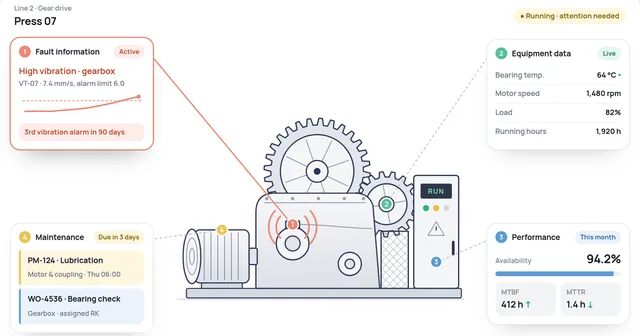
Monitor relevant machine parameters, operating status, running hours, and equipment conditions using connected industrial data.

Track historical trends, review threshold deviations, and gain visibility into asset behavior across machines, production lines, and plant areas.

By making equipment information more accessible, maintenance teams can identify unusual conditions and investigate issues before they lead to repeated operational disruptions.

02 · Faults

Fault & Recurring Failure Analysis

Understand what is affecting equipment reliability.

Capture and review available machine faults, alarms, breakdown events, and associated operating information to understand when and how equipment issues occur.

Analyze recurring failures, downtime duration, and historical fault patterns across assets and operating periods.

Connect fault information with maintenance history to support investigations and help teams identify where corrective actions may be needed.

03 · Preventive plan

Preventive Maintenance Management

Bring greater structure to planned maintenance activities.

Organize preventive maintenance schedules, routine inspections, and service activities based on defined maintenance requirements.

Track upcoming and completed maintenance tasks, maintain service records, and support timely follow-up on planned activities.

Help maintenance teams improve maintenance coordination and reduce dependence on manually maintained service schedules.

04 · Work orders

Maintenance Work Orders & Follow-up

Manage maintenance activities from issue identification to completion.

Record maintenance requirements, organize corrective activities, assign responsibilities, and track work-order progress through defined workflows.

Maintain relevant information about reported issues, maintenance actions, completion status, and service history.

Connect maintenance activities with equipment records to provide better visibility into completed work and outstanding maintenance requirements.

05 · Reliability

MTBF, MTTR & Maintenance Performance

Measure reliability and understand where improvements are needed.

Track equipment breakdowns, maintenance duration, and failure history to evaluate reliability indicators such as Mean Time Between Failures (MTBF) and Mean Time to Repair (MTTR).

Review equipment-wise maintenance performance, recurring downtime, and repair trends to identify assets requiring greater attention.

Use historical maintenance and equipment information to support reliability reviews, maintenance planning, and operational improvement initiatives.

Beyond equipment monitoring

From detecting a fault to understanding its impact.

Alarm09:42

AL-772 · High vibrationP-104 · 7.4 mm/s · limit 6.0

Work orderRK

WO-4521 · Replace bearing
  • Isolate pump
  • Replace bearing
  • Test run

P-104 historySince 2019

  1. Nov 02Bearing replacedWO-4521
  2. Oct 15LubricationPM-118
  3. Sep 30Bearing overheatingAL-731

This quarter

MTBF412 h ↑MTTR1.4 h ↓

Bearing faults on P-104: 4 → 1

With equipment information and maintenance records connected, teams can move beyond responding to individual breakdowns toward understanding equipment reliability over time.

Business benefits

Make maintenance more informed, organized, and effective.

Connecting equipment condition, work orders and service history helps maintenance teams act earlier and plan with more confidence.

  • Improved Equipment Visibility

    Access relevant equipment conditions, operating history, and fault information to better understand asset performance.

  • Reduced Recurring Disruptions

    Identify repeated failures and maintenance patterns to help teams address issues affecting equipment availability.

  • Better Maintenance Planning

    Organize preventive maintenance activities, service requirements, and follow-up tasks through structured workflows.

  • Improved Maintenance Coordination

    Connect equipment issues with maintenance work orders, responsibilities, and service records to improve operational follow-up.

  • Data-Driven Reliability Improvements

    Use equipment history, breakdown trends, MTBF, MTTR, and maintenance indicators to support reliability reviews and improvement decisions.

Build more reliable operations with connected maintenance.

From asset monitoring and fault analysis to preventive maintenance, work orders, and reliability tracking, DelphEon helps manufacturers bring equipment information and maintenance activities together.

Discuss Your Asset Maintenance Requirements